She Imagines A Spanking
A cartoon character with an active imagination has been watching her neighbors, and what does she think they get up to when the blinds are drawn? Why, spanking, of course!
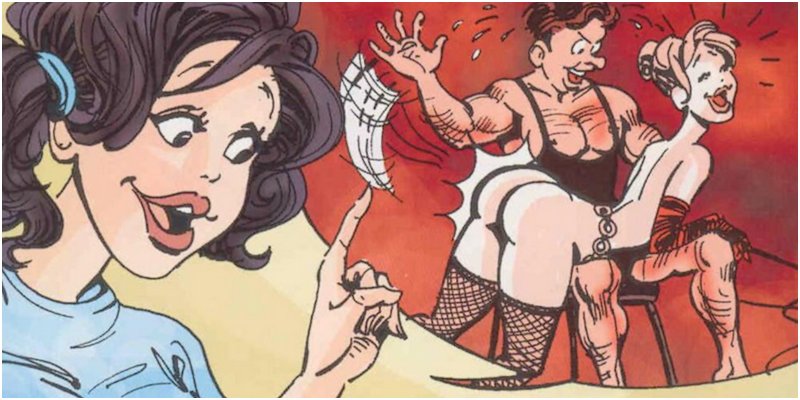
From Rooie Oortjes Cartoon Album 30.
See Also:
 |  |  |  |  |
A cartoon character with an active imagination has been watching her neighbors, and what does she think they get up to when the blinds are drawn? Why, spanking, of course!
From Rooie Oortjes Cartoon Album 30.
See Also:
Lotus Lain lured Violet Monroe to this abandoned warehouse under false premises in order to make Violet do unspeakable things. But Violet was understandably reluctant. She had to be encouraged first. And that’s when the cane came out:

From this shoot at Whipped Ass, which is a Kink Unlimited product.
See Also:
What happens when the Tornado of Terror finally gets the long-overdue punishment she has coming to her? This kind of spanking, of course!
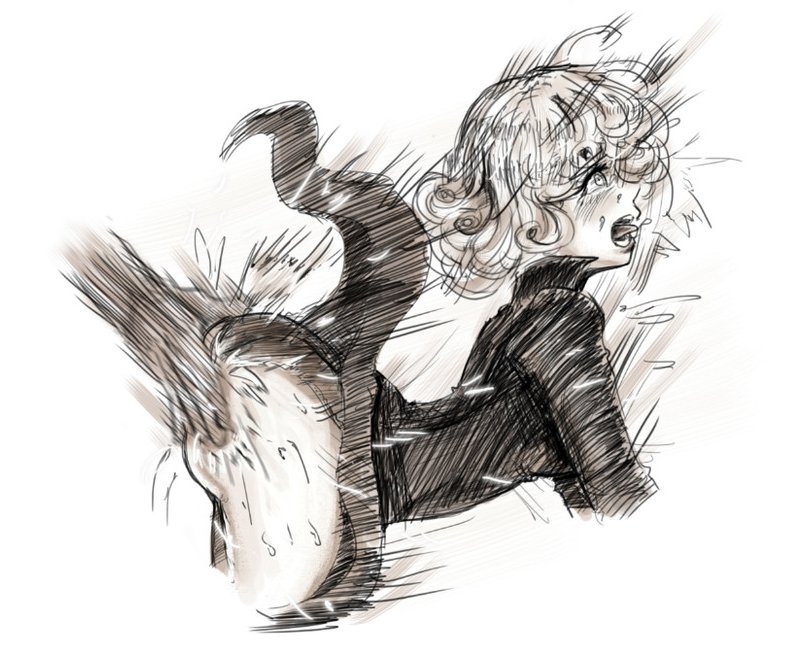
By an artist who used to go by “The Golden Smurf” on Pixiv.
See Also:

And who (or what) is Tsurumaki Maki? It’s complicated. But I’m sure she needed to be spanked:

A dude this muscular doesn’t spank like a weenie, but the wink Our Heroine is giving us? She’s letting us know she’s loving it:
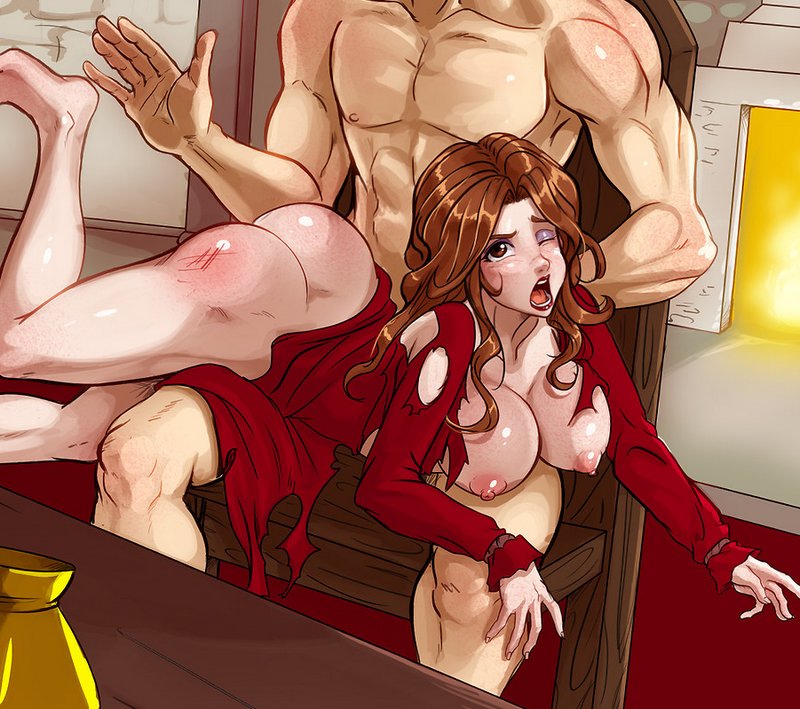
Artwork is by 7th-Heaven, who is also on Patreon as Dovoros.
See Also:
I posted this classical-looking whipping scene almost a decade ago, but now I have it in a much larger, higher-resolution, and uncropped image:
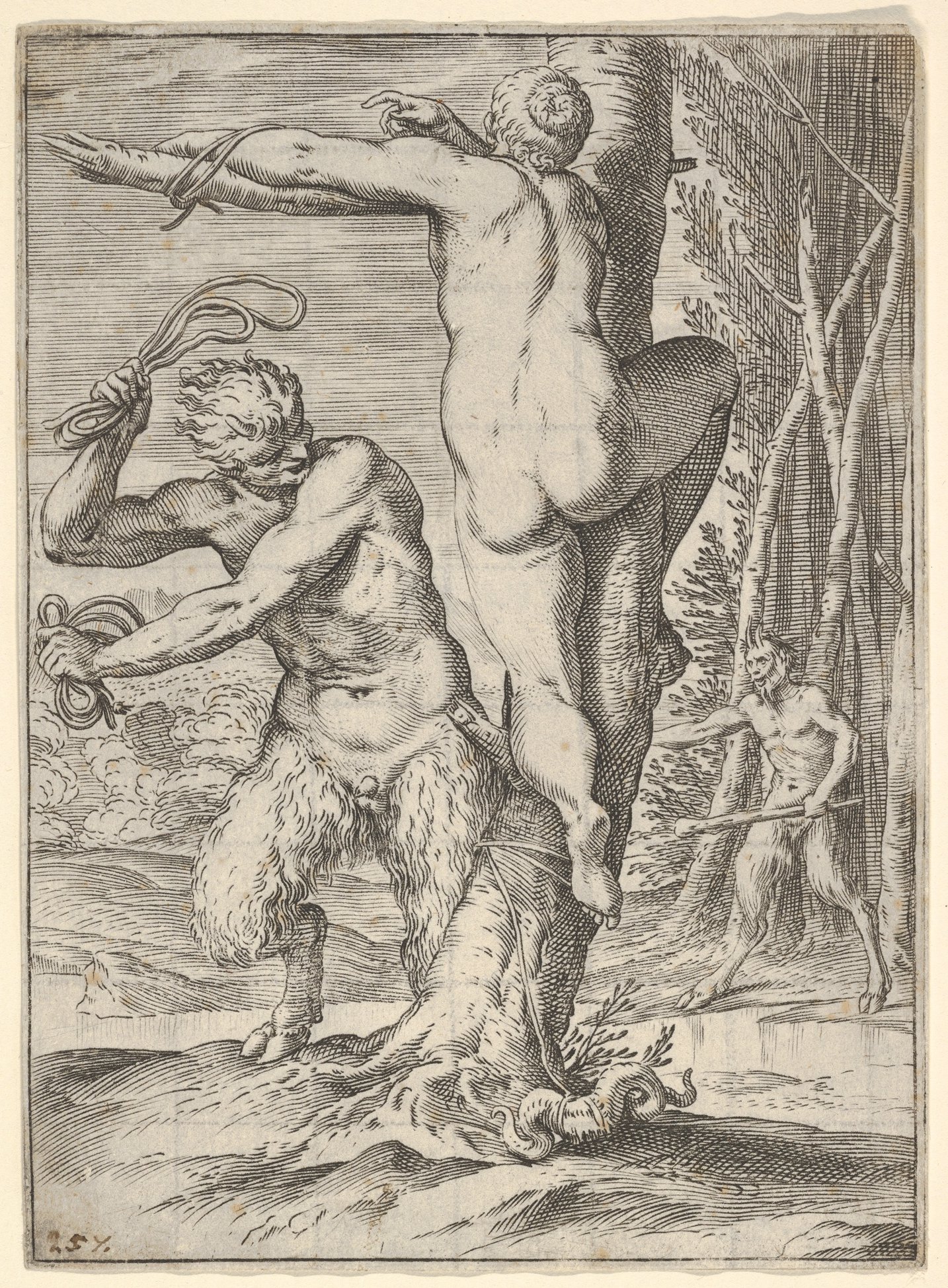
The artwork is called “Satyr Whipping A Nymph” or sometimes “Satyr Flogging A Nymph” and it’s by Italian printmaker Agostino Carracci, usually attributed to his Lascivie. What that means, precisely, is obscure, as a page at the British Museum points out:
It is unclear, however, what exactly the Lascivie were. Were they a series, or were they just a number of different prints with erotic subject matter, which were subsequently given a group name?
Baglione wrote of Agostino having composed a small book (libretto; 1642, p.390), and this was to be echoed later by Bellori (Bellori, 1976, p.129). Estimates of the number of prints that might be said to constitute the Lascivie vary. Richard Symonds thought there were 24, for he owned a: ‘Booke of 22 pieces of Venus & Cupid & Satyrs etc. want 2 the plumet & the satyr chyavando as large as the paese’. The book formed part of the collection of prints that he acquired in Rome in the years 1650 to 1651.
Bellori thought that Agostino’s libretto consisted of 16 pieces (Bellori, 1976, p.129). Malvasia seems to have been uncertain about the precise number, writing that there were either 16, or 17 if B.114 (DeGrazia 190) was included (Malvasia, 1841, I,. pp.80-81). DeGrazia’s own view (1984, pp.168ff.), largely following Malvasia, is that the group should be regarded as having been composed of B.114 + B.123/36 (her nos 176-190). She does not include B.115 (her no.211) although Malvasia did (I, p.81), and she rejects as Agostino’s at all B.112 (her R30). While her total amounts to 15, she expresses doubts about whether Agostino did mean them to form a series (1984, p.169).
Bartsch 128, 131, 133 and 134 are part of a core group of 13, all of which are set in a landscape and all more or less of the same size (150/152 mm x 102/117 mm). But they are not homogeneous in subject matter: two are biblical (B.124 &127), six are mythological narratives (B.123, 125, 126, 129, 135, 130), while five are unspecific satyr stories (B. 128, 131, 132, 133, 134). The 1648 shop inventory of the De Rossi copperplates includes: ’13 – Pezzi de lascive de Caracci in quarto’ (Consagra, 1993, pp.179 and 513, who argued that they were copies).
Their dating is also a problem. Arnoldus Buchelius bought one of them, the Venus chastising Cupid in 1599 (B.135; cited Kurz, 1951, p.232, n.4). It is sometimes said that Clement VIII rebuked Agostino for his part in the business, an idea that has been used to argue for a dating in the 1590s (Clement VIII was elected in 1592); but that depends upon a misreading of Malvasia’s text, for his mention of a Pope Clement was not a reference to Clement VIII, but to Clement VII (1523-34) and to the events surrounding the scandalous I Modi of Marcantonio (Malvasia I, p.281; see also Summerscale, 2000, pp.129-30, who clarifies the meaning).
On stylistic grounds, many of the core group of 13 could be dated to the mid to late 1580s. However B.134 (DeGrazia 187) looks different. It must have been done earlier, for the lines tend to be uniform in thickness and the modelling does not attempt the roundedness of form that Agostino was aiming at by the mid 1580s. It is difficult, in fact, to think it could have been done later than about 1582. This might suggest that the beginnings of this group of engravings lay in his first visit to Venice in that year, and they may then have occupied him on and off over a few years. The idea that they formed a conventional series seems therefore unlikely; however as he engraved new plates, Agostino made them conform to the same general format, so as to form an open-ended group.
See Also:
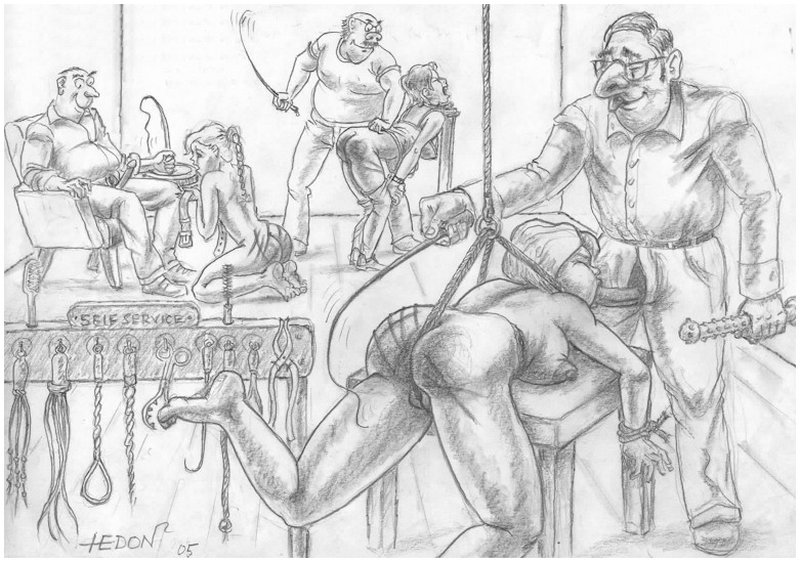
How much fun can you have with a few whips? The fellows in this cheerfully-brutal artwork by Hedon seem to have hit upon a strategy for finding out: they are throwing a bondage fellatio party!
See Also: